ROM Reconstruction
ROM Reconstruction
Goal: Rebuild all firmware ROMs from disassembled source with 100% byte accuracy.
Firmware Version History
Official firmware updates were distributed on floppy disk. All versions are archived at archive.org.
Main Board Firmware
| Version | Release Date | Notes |
|---|---|---|
| v5 | 1997-11-12 | Earliest available |
| v6 | 1998-01-16 | |
| v7 | 1998-06-26 | |
| v8 | 1998-11-13 | |
| v9 | 1999-01-26 | |
| v10 | 1999-08-02 | Current disassembly target |
HD-AE5000 Firmware
| Version | Release Date | Notes |
|---|---|---|
| v1.10i | 1998-07-06 | Initial release |
| v1.15i | 1998-10-13 | |
| v2.0i | 1999-01-15 | Added lyrics display |
Current Status
| ROM | Size | Match % | Bytes Off | Source File |
|---|---|---|---|---|
| Main CPU | 2MB | 100% | 0 | maincpu/kn5000_v10_program.s |
| Sub CPU Payload | 192KB | 100% | 0 | subcpu/kn5000_subprogram_v142.s |
| Sub CPU Boot | 128KB | 100% | 0 | subcpu/boot/kn5000_subcpu_boot.s |
| Table Data | 2MB | 100% | 0 | table_data/kn5000_table_data.s |
| Custom Data | 1MB | 100% | 0 | custom_data/kn5000_custom_data.s |
| HDAE5000 (HD Expansion) | 512KB | 100% | 0 | hdae5000/hd-ae5000_v2_06i.s |
Disassembly Status Visualization
The diagram below shows the disassembly status of each ROM component. Colors indicate the type of content at each address:
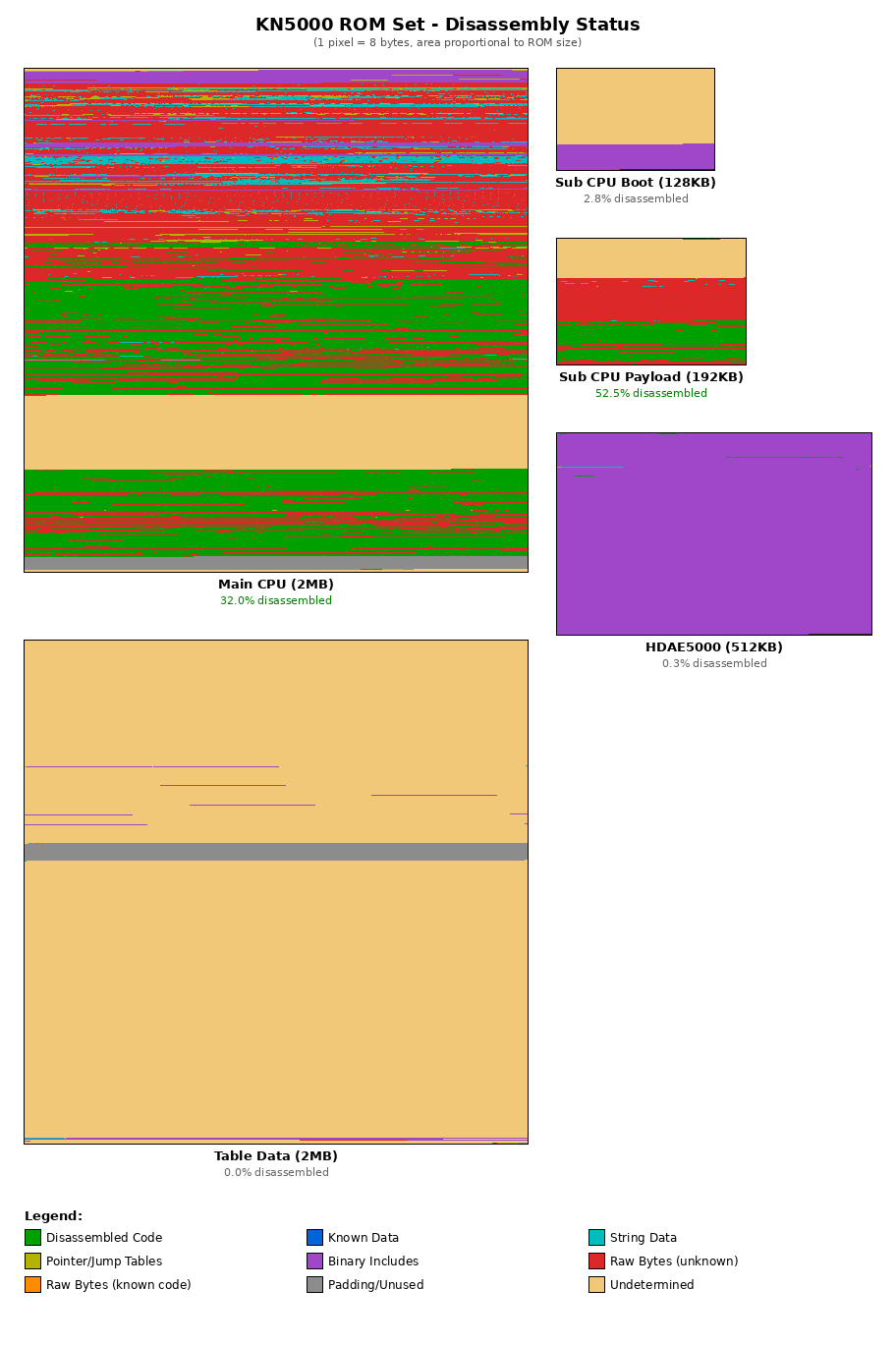
Legend:
- Green = Disassembled code (symbolic instructions with meaningful labels)
- Blue = Known data structures (documented tables, configs)
- Cyan = String data (text, messages, labels)
- Light Green = Pointer/jump tables (address references)
- Purple = Binary includes (external files not yet analyzed)
- Red = Raw bytes with unknown meaning (needs investigation)
- Orange = Raw bytes known to be code (awaiting disassembly)
- Gray = Padding/unused (0x00 or 0xFF fill)
- Yellow = Undetermined (not yet categorized)
The width of each rectangle is proportional to the ROM’s file size. This visualization is automatically regenerated via make website to stay in sync with disassembly progress.
Original ROM Files
The original firmware dumps are stored in original_ROMs/:
| File | Size | Description |
|---|---|---|
kn5000_v10_program.rom |
2MB | Main CPU program ROM |
kn5000_subprogram_v142.rom |
192KB | Sub CPU payload (sent by main CPU at boot) |
kn5000_subcpu_boot.ic30 |
128KB | Sub CPU boot ROM |
kn5000_table_data_rom_odd.ic1 |
1MB | Table data ROM (odd bytes) |
kn5000_table_data_rom_even.ic3 |
1MB | Table data ROM (even bytes) |
kn5000_custom_data.ic19 |
1MB | Custom data flash (user storage) |
hd-ae5000_v2_06i.ic4 |
512KB | HDAE5000 hard disk expansion ROM |
Reference disassembly files (.unidasm) are generated with MAME’s unidasm tool for analysis.
Assembler
The project uses a custom LLVM backend (llvm-mc -triple=tlcs900) for assembly. All ~370,000 instructions are encoded natively — no workaround macros needed.
Build Process:
llvm-mcassembles.sfiles to ELF object filesld.lldlinks with a linker script to set the ROM base addressllvm-objcopyextracts the raw binary from the ELFcompare_roms.pyverifies byte-for-byte match against originals
History: The project originally used ASL (Alfred Arnold’s Macro Assembler), which only supported TMP96C141 — requiring 110+ workaround macros for TMP94C241F-specific instructions. The LLVM backend was developed to encode all TLCS-900/H2 instructions natively. ASL sources are archived in archive/asl/ for reference.
Milestone: 100% Byte-Matching ROMs
As of March 2026, all six ROMs rebuild with 100% byte accuracy using LLVM assembly (~370,000 native instructions, 0 workaround macros):
- Main CPU (2MB) - Complete disassembly with symbolic labels (239,683 native instructions, 0 code .byte remaining)
- Sub CPU Payload (192KB) - Full protocol implementation (35,747 instructions)
- Sub CPU Boot (128KB) - Boot ROM with VGA initialization (1,357 instructions)
- Table Data (2MB) - Feature demo, wallpapers, icons, bootloader (1,678 instructions)
- HDAE5000 (512KB) - Hard disk expansion firmware (502 instructions)
- Custom Data (1MB) - User storage (data-only, byte-exact reconstruction)
Source File Organization
Main CPU
The Main CPU disassembly is organized into modular source files for maintainability:
| File | Lines | Description |
|---|---|---|
maincpu/kn5000_v10_program.s |
~43,000 | Main source file (includes 94+ other files) |
maincpu/gui_constants.s |
57 | Display state variables, offscreen buffers |
maincpu/fdc_constants.s |
75 | FDC I/O addresses, commands, status bits |
maincpu/fdc_routines.s |
1,403 | FDC read/write/seek routines |
maincpu/midi_encoder_constants.s |
85 | MIDI CC and encoder RAM/ROM addresses |
maincpu/midi_encoder_routines.s |
268 | Encoder dispatch and MIDI CC processing |
maincpu/cpanel_constants.s |
164 | Control panel state, buffers, button/LED mappings |
maincpu/cpanel_routines.s |
1,506 | Control panel serial protocol handlers |
maincpu/sysex_routines.s |
239 | MIDI System Exclusive message handlers |
maincpu/demo_routines.s |
290 | Feature Demo mode handlers |
maincpu/computer_interface_config.s |
310 | Computer Interface connection configuration |
maincpu/computer_interface_pcg.s |
703 | Computer Interface PCG (Program Change) output |
maincpu/midi_serial_routines.s |
995 | MIDI serial communication (SC0) |
maincpu/sound_editor_routines.s |
629 | Sound Editor mode and title functions |
maincpu/smf_playback.s |
695 | SMF song playback routines |
maincpu/smf_config_routines.s |
3,263 | SMF configuration and slot parameters |
maincpu/seq_step_routines.s |
3,089 | Step-mode sequencer routines |
maincpu/audio_cmd_encoder.s |
3,100 | Audio command byte formatter |
maincpu/semenu_routines.s |
3,431 | Sound editor menu system |
maincpu/setwall_routines.s |
1,940 | Accompaniment style wall parser |
maincpu/rhythm_routines.s |
1,580 | Rhythm pattern processing |
maincpu/accompseq_routines.s |
1,961 | Accompaniment sequencer |
maincpu/audioinit_routines.s |
2,505 | Audio subsystem initialization |
maincpu/bmdredit_routines.s |
4,434 | Beat/drum editor |
maincpu/drawing_primitives.s |
4,567 | Line/box/frame/bitmap/string drawing |
maincpu/bitmap_out_routines.s |
4,347 | Bitmap output/display compositing |
maincpu/rvari_routines.s |
2,752 | Registration variation selection UI |
maincpu/psgridbox_routines.s |
1,138 | Performance settings grid box UI |
maincpu/fdemotext_routines.s |
2,334 | Feature demo text rendering |
maincpu/sndparam_routines.s |
2,042 | Sound parameter lookup/storage |
maincpu/midipkt_routines.s |
1,178 | MIDI packet construction |
maincpu/msp_factory_defaults.s |
— | MSP factory default settings |
maincpu/file_io/title_handlers.s |
349 | File I/O title entry handlers |
maincpu/file_io/disk_operations.s |
1,297 | File copy, rename, format, disk info |
maincpu/file_io/filename_password.s |
807 | Filename and password UI |
maincpu/file_io/composer_filters.s |
968 | Composer load and filter operations |
maincpu/file_io/smf_operations.s |
1,312 | Standard MIDI File operations |
maincpu/file_io/wallpaper.s |
519 | Wallpaper loading |
maincpu/file_io/single_load.s |
2,298 | Single file load operations |
maincpu/file_io/medley.s |
4,690 | Medley playback (disk, internal, SMF, PD, doc) |
maincpu/file_io/misc_ui.s |
969 | Jump insert, priority, setup, filename box |
maincpu/accompaniment_engine.s |
32,516 | Accompaniment, auto-play, pedal, style engine |
maincpu/sequencer_engine.s |
32,056 | Sequencer part/play, note editing |
maincpu/note_voice_mapping.s |
26,090 | Note mapping, voice management, MIDI routing |
maincpu/ui_widget_defs.s |
19,616 | UI widget definitions, screen/window/view IDs |
maincpu/sound_editor_ui.s |
16,567 | Sound editor menus and grids |
maincpu/drawbar_panel_ui.s |
15,526 | Drawbar, accordion, panel memory UI |
maincpu/sequencer_ui.s |
14,292 | Sequencer playback/edit UI |
maincpu/mode_screens.s |
12,905 | MSA mode, panel memory, effect mode screens |
maincpu/midi_voice_routing.s |
11,498 | MIDI dispatch, voice routing |
maincpu/scoop_display.s |
10,363 | Display update manager |
maincpu/naka_dispatch.s |
9,746 | Central dispatch, UI state |
maincpu/naka_descriptors.s |
9,324 | Descriptor tables, bitmap data |
maincpu/file_demo_proc.s |
8,355 | File I/O, demo processing |
maincpu/style_data_init.s |
8,246 | Style data, task scheduling |
maincpu/voice_synth.s |
8,042 | Sound generation, voice synthesis |
maincpu/dsp_config_sysex.s |
5,881 | DSP config, SysEx handlers |
maincpu/naka_style_bitmap.s |
5,909 | Style groups, bitmap data |
maincpu/tonegen_voice_ctrl.s |
5,185 | Tone generator, voice control |
maincpu/voice_midi_buf.s |
4,202 | Voice MIDI buffers |
Total extracted code: ~384,000 lines across 94 include files (90% of main CPU source)
Subsystem Descriptions:
FDC (Floppy Disk Controller):
fdc_constants.s: Memory-mapped I/O addresses (0x110000 base), command codes (uPD765-compatible), status register bit definitionsfdc_routines.s: Complete FDC handler includingFDC_COMMAND_DISPATCHER,FDC_HANDLER_01throughFDC_HANDLER_11,Reset_Floppy_Disk_Controller,Check_for_Floppy_Disk_Change
MIDI/Encoder:
midi_encoder_constants.s: MIDI CC value storage, raw encoder inputs, lookup table addressesmidi_encoder_routines.s:CPanel_EncoderDispatch,Encoder_ProcessModwheel,Encoder_ProcessVolume,Encoder_ProcessBreath,Encoder_ProcessFoot,Encoder_ProcessExpression
Control Panel:
cpanel_constants.s: State machine variables, RX/TX buffers, button state arrays with bit mappings, LED row/pattern mappingscpanel_routines.s: Serial protocol handlers (CPanel_SM_*), packet processors (CPanel_RX_*), LED control, buffer management
SysEx (System Exclusive):
sysex_routines.s:ExcSendFunc,ExcPmemFunc(Panel Memory),ExcSmemFunc(Sound Memory),ExcCompFunc(Composer),ExcSeqFunc(Sequence),ExcMspFunc(MSP)
Feature Demo:
demo_routines.s:DemoModeFunc,DemoStyleTtlFunc,DemoSoundTtlFunc,DemoRhyTtlFunc
Computer Interface:
computer_interface_config.s:TtComputerConnection,MdCmptCnctFunc,MdPcgModeFunc,MdDrumTypeFunc,MdSetupLoadFunccomputer_interface_pcg.s:TtMdPcgOut,AcPcgOutGridBoxProc,PcgOutGridCheck,PcgOutSendFunc,MainPcgOutSend
MIDI Serial (SC0):
midi_serial_routines.s:INTTX0_HANDLER,INTRX0_HANDLER,READ_COM_SELECT_SWITCH, SC0 initialization
Sound Editor:
sound_editor_routines.s: 32 Sound Editor functions includingSeMenuModeFunc,SeMenuTitleFunc,SeEasyTitleFunc,SeTonTon1/2TitleFunc,SePitPit1TitleFunc,SeAmpAmp1/2TitleFunc,SeFilLpq1TitleFunc,SeDigEffTitleFunc,SeCtr2/3TitleFunc,SeCopyTitleFunc,SeWrtMemTitleFunc,SeWrtSndTitleFunc
File I/O & Disk Operations (in maincpu/file_io/ subdirectory):
title_handlers.s: Entry handlers (LoadTtlJgFunc,SaveTtlJgFunc,SetupFlashFunc,FmmUtilityTitleFunc)disk_operations.s: File operations (FileCopyFunc,FileRenameFunc,FmmFormatFunc,DiskNameFunc,DiskInfoFunc)filename_password.s: UI routines (FmmPasswordFunc,FmmFileNameFunc)composer_filters.s: Composer and filters (FmmComposerLoadFunc,FmmLoadFilterFunc,FmmSaveFilterFunc)smf_operations.s: Standard MIDI File (FmmSmfLoadTitleFunc,SmfLoadAsFunc,FmmSmfFileNameFunc)wallpaper.s: Wallpaper loading (FmmWallpaperLoadFunc)single_load.s: Single file load (SingleLoadModeFunc,SingleLoadSrcFunc,SingleLoadDstFunc)medley.s: All medley modes (FmmIntMedleyFunc,FmmDiskMedley*Func,FmmSmfMedleyFunc,FmmDocMedleyFunc)misc_ui.s: Utilities (JumpInsertFunc,SetupOkFunc,PsFileNameBoxProc)
Sequencer (Reference Only):
sequencer_reference.s: Documents 61 sequencer functions scattered across the ROM (not extracted due to interleaving with other code)
GUI Constants:
gui_constants.s: Display dirty flags (0x0205E4), offscreen buffer addresses (0x043C00, 0x056800, 0x05FE00, 0x069400), screen dimensions (320x240 @ 8bpp)
Palettes:
Two color palettes have been extracted as binary includes:
- Palette 1 at 0xEB37DE - first palette (inline in sequential section)
- Palette 2 at 0xEEFAF0 - second palette (
Palette_8bit_RGBA_2.bin)
Sub CPU Boot (100% COMPLETE!)
The Sub CPU boot ROM has achieved 100% byte-perfect reconstruction!
All routines fully disassembled:
SUB_8437(0xFF8437) - Tone generator initialization loopSUB_850E(0xFF850E) - Multi-register push/call wrapperSUB_853A(0xFF853A) - Write register pairs to tone generatorCOPY_WORDS(0xFF858B) - Word block copy usingldirwFILL_WORDS(0xFF8594) - Memory fill with word valuesCHECKSUM_CALC(0xFF859B) - Calculate checksum over memory rangeSUB_8B37(0xFF8B37) - LED/output bit manipulation routineSUB_8B89(0xFF8B89) - Inter-CPU communication handler (reads from 0x110000 latches)SUB_8BD2(0xFF8BD2) - Note/velocity calculation with lookup tablesSUB_8C75(0xFF8C75) - Hardware register write helper (0x100000)SUB_8C80(0xFF8C80) - Hardware calibration routine with timeout loopSUB_8D0A(0xFF8D0A) - Hardware parameter write (21 param pairs)SUB_8F57(0xFF8F57) - Hardware write with delaySUB_FE80-FEC1(0xFFFE80) - Debug/diagnostic routines (hex output, string output)- Vector trampolines and interrupt handlers
DMA Transfer Routines (0xFF8604-0xFF881E):
These routines handle DMA-based data transfer between the Sub CPU and Main CPU:
| Routine | Address | Size | Description |
|---|---|---|---|
SendData_Chunked |
0xFF8604 | 69 bytes | Send data in 32-byte chunks via DMA |
SendData_Block |
0xFF8649 | 99 bytes | Send single data block via DMA |
SendCmd_E3 |
0xFF86AC | 48 bytes | Send E3 (payload ready) command |
SendParams_E2 |
0xFF86DC | 112 bytes | Wait for DMA, then send E2 command |
TwoPhase_Transfer |
0xFF874C | 211 bytes | Two-phase DMA with E1 command, 200-cycle delays |
Inter-CPU Communication Protocol:
- Uses handshaking via
INTERCPU_STATUSregister at 0x34:- Bit 0: Sub CPU ready flag (set when ready, cleared when starting transfer)
- Bit 1: Completion signal from interrupt handler
- Bit 2: Gate for command processing in InterCPU_RX_Handler
- Bit 4: Main CPU ready flag (polled by sub CPU)
- Commands sent via
INTER_CPU_LATCHat 0x120000:- E1 command: Multi-stage DMA transfer (two-phase with 200-cycle delays)
- E2 command: Payload transfer (10-byte parameter block)
- E3 command: Payload ready signal (sets bit 6 of SUBCPU_STATUS_FLAGS)
- Other: Low 5 bits = byte count-1, high 3 bits = handler index from table
Key memory locations discovered:
DMA_BURST_CTRL(0x0102) - DMA burst mode configuration registerPAYLOAD_LOADED_FLAG(0x04FE) - Payload ready indication flagDMA_SETUP_PARAMS(0x0502) - DMA parameter storage (XWA, XDE, BC)E1_XFER_PARAMS(0x050C) - E1 command transfer parameters (two-phase phase 1)DMA_XFER_STATE(0x0516) - DMA transfer state: 0=idle, 1=single xfer, 2=two-phaseE2_XFER_PARAMS(0x053E) - E2 command transfer parameters (two-phase phase 2)AUDIO_HW_BASE(0x100000) - Audio hardware registers (DSP/DAC)
Encoding fixes applied:
jrl T(3-byte relative long jump) vsjp(4-byte absolute)ldirencoding: TMP94C241 uses83 11, ASL generates85 11ld r, imm8encoding: TMP94C241 uses different opcodes for A, D, E, L, Wld (XIX/XHL), imm16encoding: 4-byte vs 3-byteld (24-bit addr), imm16encoding: 7-byteLD_MEM24_IMM16macro
This marks the second 100% complete ROM in the project, after Sub CPU Payload!
Table Data (66.70% incorrect)
The Table Data ROM contains the first-stage bootloader, Feature Demo presentation data, and various lookup tables.
First-Stage Bootloader (100% matching):
The boot code section (0x9FB4D2-0x9FFFFF, 19,246 bytes) is now 100% byte-matching. This includes:
| Component | Address Range | Size | Description |
|---|---|---|---|
Boot_BitMaskTable |
0x9FB4D2-0x9FB4E7 | 22 bytes | Initialization data tables |
Boot_Init |
0x9FB4E8-0x9FB704 | 540 bytes | CPU/memory controller initialization |
Boot_EnterHalt |
0x9FB705-0x9FB73F | 59 bytes | HALT handler and interrupt dispatcher |
Boot_ClearRAM |
0x9FB740-0x9FB7F1 | 178 bytes | RAM initialization and data copy |
| Boot routines (pre-LZSS) | 0x9FB7F2-0x9FC8C1 | 4,304 bytes | Flash update, FDC, display utilities |
| LZSS Decoder Suite | 0x9FC8C2-0x9FCA4F | 872 bytes | Complete decompression subsystem |
| Boot routines (post-LZSS) | 0x9FCC2A-0x9FFEE0 | 12,982 bytes | Remaining boot utilities |
RESET_HANDLER |
0x9FFEE0-0x9FFEFF | 32 bytes | Entry vector (JP to Boot_Init) |
| Interrupt vectors | 0x9FFF00-0x9FFFFF | 256 bytes | TMP94C241F vector table |
LZSS Decoder Routines (fully disassembled):
| Routine | Address | Size | Purpose |
|---|---|---|---|
LZSS_ReadByte |
0x9FC8C2 | 115 bytes | Read from compressed stream with sector buffering |
LZSS_OutputByte |
0x9FC935 | 63 bytes | Write decompressed bytes with 32-bit batching |
LZSS_OutputByte_Alt |
0x9FC974 | 63 bytes | Alternative output for flash update mode |
LZSS_ParseHeader |
0x9FC9B3 | 157 bytes | Parse/validate firmware header, setup source |
LZSS_Decompress |
0x9FCA50 | 474 bytes | Main decompression loop with sliding window |
The LZSS decoder uses the SLIDE4K format (4KB sliding window, 12-bit offset, 4-bit length) and is invoked during flash firmware updates to decompress packed firmware files.
Key discovery: The interrupt vector table contains boot-time addresses (0xFFxxxx) because at reset the table_data ROM is mapped at 0xE00000-0xFFFFFF, not 0x800000-0x9FFFFF. The bootloader reconfigures the memory controller to remap the ROMs.
System Update Bitmaps (shared with Main CPU):
The Table Data ROM contains 8 system update message bitmaps at 0x9FA156. These are 1-bit monochrome images (224x22 pixels, 616 bytes each) that are byte-identical to the Main CPU versions. The disassembly source shares the same bitmap files between both ROMs.
| Address | Image | Purpose |
|---|---|---|
| 0x9FA156 | Flash Memory Update | Update in progress |
| 0x9FA3BE | Now Erasing | Flash erase in progress |
| 0x9FA626 | FD to Flash Memory | Copying from floppy |
| 0x9FA88E | Completed | Operation complete |
| 0x9FAAF6 | Please Wait | Processing |
| 0x9FAD5E | Change FD 2 of 2 | Multi-disk prompt |
| 0x9FAFC6 | Illegal Disk | Invalid disk error |
| 0x9FB22E | Turn On AGAIN | Restart instruction |
ROM Interleaving: The Table Data ROM uses 16-bit word-level interleaving across two physical chips (odd.ic1 and even.ic3). The combined ROM file kn5000_table_data.rom is created by alternating 16-bit words from each chip, not individual bytes.
Shared Code with Main CPU (bootloader routines):
Analysis revealed that several bootloader routines in the Table Data ROM are byte-identical or semantically identical to utility routines in the Main CPU ROM. This indicates both ROMs were built from common source code.
Shared Source Files (in shared/ directory):
The disassembly now uses actual shared source files that are included by both ROMs:
| File | Lines | Description |
|---|---|---|
shared/vga_constants.s |
58 | VGA register addresses and constants |
shared/vga_init.s |
135 | VGA initialization data tables |
shared/vga_init.s |
28 | VGA init completion code |
shared/vga_io.s |
51 | VGA register I/O routines (byte-identical) |
shared/boot_call_init_handlers.s |
87 | Init handler dispatch (conditional assembly) |
shared/boot_routines.s |
630 | Boot initialization routines |
shared/boot_routines.s |
85 | LZSS compression decoder |
Total shared source: 1,074 lines across 7 files
Shared Routine Mapping:
| Table Data | Main CPU | Size | Routine |
|---|---|---|---|
| 0x9FCDFC-0x9FCE1D | 0xEF5141-0xEF515F | 30-34 bytes | Write_VGA_Register, Read_VGA_Register |
| 0x9FB70A-0x9FB73F | 0xEF086F-0xEF08A3 | 53-54 bytes | Boot_CallInitHandlers |
| 0x9FCD9A-0x9FD7BD | 0xEF50DF-0xEF5B02 | 2,596 bytes | VRAM_FillRect and display routines |
| 0x9FBC3C-0x9FBECF | 0xEF3CE0-0xEF3F73 | 660 bytes | Boot utility routines |
| 0x9FB4F2-0x9FB622 | 0xEF03D0-0xEF0500 | 305 bytes | Boot initialization code |
Conditional Assembly:
Some shared routines have minor encoding differences between ROMs (e.g., byte vs word comparison, different helper addresses). These are handled with conditional assembly:
; Example from boot_call_init_handlers.s
IF INIT_FLAG_COMPARE_WORD
  ; table_data: CP (0xFFFEEE), 0xFFFF (7 bytes)
  db 0D2h, 0EEh, 0FEh, 0FFh, 03Fh, 0FFh, 0FFh
ELSE
  ; maincpu: CP (0xFFFEEE), 0xFF (6 bytes)
  db 0C2h, 0EEh, 0FEh, 0FFh, 03Fh, 0FFh
ENDIF
Each ROM defines the required parameters before including the shared file.
Compressed Data Identified:
| Address | Contents | Format |
|---|---|---|
| 0x8E0000 | Compressed preset/parameter data | SLIDE4K LZSS (~33KB decompressed) |
| 0x9FA000 | Update file type headers | “SLIDE” markers |
Note: The LZSS data at 0x8E0000 decompresses to ~33KB of parameter data, NOT the ~192KB Sub CPU executable. See LZSS Compression for analysis.
Reference disassembly: original_ROMs/table_data_bootcode.unidasm (6,704 lines)
Remaining work:
- Feature Demo XML and BMP images (documented but not all extracted)
- Analysis of decompressed parameter data from 0x8E0000
- Trace Sub CPU payload transfer path during boot
- Various lookup tables and data structures
- Boot routines in
bootcode_pre_lzss.binandbootcode_post_lzss.bin
Technical Notes
TMP94C241F vs TMP96C141
Instructions unique to TMP94C241F that require macro workarounds:
- Memory-to-memory
LD(not supported by TLCS-900) - Certain shift/rotate variants
- Some MUL/DIV variants
- LDI, LDIR, LDD, LDDR block transfer instructions
- DMA control register access (
LDCwith DMAS/DMAD/DMAC/DMAM registers)
ASL Macro Workarounds (tmp94c241.inc)
The tmp94c241.inc file contains macros that emit raw byte sequences for unsupported instructions.
DMA Register Macros:
| Macro | Encoding | Description |
|---|---|---|
LDC_DMAS0_XWA |
e8 2e 00 |
Load DMA source 0 from XWA |
LDC_DMAS2_XDE |
ea 2e 08 |
Load DMA source 2 from XDE |
LDC_DMAS2_XHL |
eb 2e 08 |
Load DMA source 2 from XHL |
LDC_DMAD0_XWA |
e8 2e 20 |
Load DMA destination 0 from XWA |
LDC_DMAD0_XBC |
e9 2e 20 |
Load DMA destination 0 from XBC |
LDC_DMAD2_XWA |
e8 2e 28 |
Load DMA destination 2 from XWA |
LDC_DMAC0_WA |
d8 2e 40 |
Load DMA count 0 from WA |
LDC_DMAC0_A |
c9 2e 42 |
Load DMA count 0 from A |
LDC_DMAC2_A |
c9 2e 4a |
Load DMA count 2 from A |
LDC_DMAC2_BC |
d9 2e 48 |
Load DMA count 2 from BC |
LDC_DMAC2_WA |
d8 2e 48 |
Load DMA count 2 from WA |
Additional Sub CPU Boot ROM Macros:
| Macro | Encoding | Description |
|---|---|---|
INC_0_XBC |
e9 60 |
Increment XBC by 1 |
PUSH_WORD value |
0b LL HH |
Push 16-bit immediate |
CP_pXWA_WORD value |
90 3f LL HH |
Compare (XWA) with 16-bit immediate |
CP_pXBC_d_WORD d,val |
99 dd 3f LL HH |
Compare (XBC+d) with 16-bit immediate |
LDA_XWA_IMM24 value |
f2 LL MM HH 30 |
Load 24-bit address into XWA |
CALR target |
1e LL HH |
Call relative (3-byte encoding) |
CALL_ABS24 target |
1d LL MM HH |
Call absolute with 24-bit address |
JRL_T target |
78 LL HH |
Jump relative long (always true) |
LDIR_94 |
83 11 |
Block copy (TMP94C241 encoding) |
LD_A value |
21 nn |
Load immediate to A register |
LD_D value |
24 nn |
Load immediate to D register |
LD_E value |
25 nn |
Load immediate to E register |
LD_L value |
27 nn |
Load immediate to L register |
LD_W value |
20 nn |
Load immediate to W register |
LD_pXIX_IMM16 value |
b4 02 LL HH |
Store 16-bit imm to (XIX) |
LD_pXHL_IMM16 value |
b3 02 LL HH |
Store 16-bit imm to (XHL) |
LD_MEM24_IMM16 addr,val |
f2 LL MM HH 02 VV WW |
Store 16-bit to 24-bit addr |
Stack Frame and Register Macros (DMA routines):
| Macro | Encoding | Description |
|---|---|---|
DEC_6_XSP |
ef 6e |
Decrement XSP by 6 (allocate stack frame) |
INC_6_XSP |
ef 66 |
Increment XSP by 6 (deallocate stack frame) |
LD_IZ_BC |
d9 8e |
Load IZ from BC |
CP_IZ_imm16 val |
de cf LL HH |
Compare IZ with 16-bit immediate |
SUB_IZ_imm16 val |
de ca LL HH |
Subtract 16-bit immediate from IZ |
LD_C_IZL |
c7 f8 8b |
Load C from low byte of IZ |
EXTZ_WA |
d8 12 |
Zero-extend A to WA |
EXTZ_BC |
d9 12 |
Zero-extend C to BC |
Stack-Relative Addressing Macros:
| Macro | Encoding | Description |
|---|---|---|
LD_A_pXSP_d disp |
8f dd 21 |
Load A from (XSP+disp) |
LD_XDE_pXSP_d disp |
af dd 22 |
Load XDE from (XSP+disp) |
LD_XBC_pXSP_d disp |
af dd 21 |
Load XBC from (XSP+disp) |
LD_pXSP_d_A disp |
bf dd 41 |
Store A to (XSP+disp) |
LD_pXSP_d_XDE disp |
bf dd 62 |
Store XDE to (XSP+disp) |
ADD_pXSP_d_XWA disp |
af dd 88 |
Add XWA to (XSP+disp) |
Encoding Differences
ASL sometimes chooses different (but functionally equivalent) encodings than the original ROM:
| Instruction | Original | ASL Default | Notes |
|---|---|---|---|
lda XWA, imm16 |
5-byte (24-bit addr) | 4-byte (16-bit) | Use LDA_XWA_IMM24 macro |
call addr |
3-byte calr |
4-byte call |
Use CALR macro when target is within range |
jp addr |
3-byte jrl T |
4-byte jp |
Use JRL_T macro for relative long jump |
ldir |
83 11 |
85 11 |
Use LDIR_94 macro for TMP94C241 encoding |
ld A, imm8 |
21 nn |
Different | Use LD_A macro |
ld D, imm8 |
24 nn |
Different | Use LD_D macro |
These encoding differences cause byte mismatches even when the code is functionally correct.
Build Process
cd kn5000-roms-disasm
make all              # Build all ROMs
python compare_roms.py # Verify against originals
Recent Improvements
March 2026: Sound Data C Struct Conversion and Code Quality
15 sound data files converted to C structs — Raw byte arrays in maincpu/audio/sound_data/ converted to typed C struct arrays with named fields, section labels, and _Static_assert size verification. Files include piano, guitar, strings/vocal, organ, brass, flute, sax/reed, mallet/orch perc, drum kits, and more. The sepaout_config.s data was also converted to a C struct with separator/output configuration fields.
1,398 generic labels renamed to semantic names — Remaining hex-suffixed parameter labels, .set aliases, and address-based labels across all source files replaced with sequential or descriptive names.
LLVM backend improvements — Misaligned memory access fix, D7 prevbank disassembler fix, SRI prefix encoding fix for R+d16 addressing, F0 8-bit direct memory support, auto-increment addressing, round-trip assembly tests, .word/.hword directive support, and calr relative call fix. Backend documentation added.
MAME driver style audit passed — All upstream PR branches reviewed for MAME code style compliance.
March 2026: Complete LABEL_XXXXXX Elimination
All address-based labels replaced with semantic names across the entire ROM set. Every LABEL_XXXXXX placeholder (e.g., FileIO_ValidateWithExtHeader) has been analyzed and renamed to a meaningful, descriptive name reflecting its purpose (e.g., FileIO_ValidateWithExtHeader, SeqByteBlock_DispatchJumpTable). This represents the completion of a major project goal:
- ~10,000 labels renamed across 94+ source files in maincpu alone
- 0 LABEL_XXXXXX remaining in any ROM directory (maincpu, subcpu, hdae5000, table_data, custom_data)
- All renames verified with full
make clean && make all+compare_roms.py(100% byte match maintained) - Cross-file references updated atomically to prevent broken symbol errors
This milestone significantly improves codebase navigability and makes the disassembly a true semantic representation of the firmware, not just a mechanical address-to-instruction translation.
March 2026: R+d16 Addressing, Semantic Naming, Symbolic Handlers, Waveform ROM
357 R+d16 .byte instructions converted to native mnemonics — With new LLVM backend support for R+d16 source memory addressing (C3/D3/E3 SRI prefix), 357 .byte fallbacks across maincpu and subcpu ROMs were converted to native assembly. Largest contributors: midi_dispatch_handlers (173), subprogram (26), sequencer_ui (25), scoop_display (23), graphics_text_vga (22). All 6 ROMs maintain 100% byte match.
16 NAKA UI widget files renamed to semantic names — Previously opaque address-based filenames (e.g., ui_widgets_EBxxxx.s) renamed to descriptive names based on reverse engineering research (e.g., technichord_string_data.s, sound_editor_widgets.s), improving codebase navigability.
All 26 NAKA widget C files converted to named struct format — Raw unsigned char data[N] = { 0xNN, ... } byte arrays replaced with packed C structs using named fields, NAKA_HDR() type headers, NAKA_ADDR() pointer symbol resolution, and _Static_assert size verification. Pointer tables have 800+ external symbols resolved via ELF symbol table. Named regions derived from .equ offsets in assembly wrappers provide clear structural decomposition of widget descriptors, string tables, bitmap data, palette entries, and handler configuration.
All C screen data .handler fields now use symbolic references — 52 handler symbols across 2 linker scripts (maincpu.ld, ctlonly.ld) replace raw numeric addresses in the C-compiled screen data structures, enabling cross-reference navigation and maintaining the link between C UI definitions and assembly handler routines.
IC307 waveform ROM format fully decoded — The waveform ROM (IC307, 4MB) format has been fully reverse-engineered: 16-bit signed PCM samples at 32kHz, organized as a sample table (512 entries with start/end/loop addresses) followed by raw sample data. See Waveform ROM Format for full documentation.
Binary Include Splitting
Per project policy, binary includes are split when code references internal addresses. This ensures:
- Cross-references use symbolic labels instead of hardcoded addresses
- Smaller binary files are easier to analyze
- Data structure boundaries are explicitly marked
Recently split:
e02510_e06baf.binsplit into three parts:e02510_e0458f.bin- Instrument category data (PIANO, ORGAN, etc.)e04590_e04b2f.bin- GUITAR datae04b30_e06baf.bin- STRINGS & VOCAL data
e06f30_e0adcf.binsplit into four parts:e06f30_e078f1.bin- FLUTE sound datae078f2_e08baf.bin- Additional FLUTE datae08bb0_e0914f.bin- SAX & REED sound datae09150_e0adcf.bin- MALLET & ORCH PERC sound data
e0bb90_e0e974.binsplit into seven parts for instrument data tablese0b250_e0ba60.binsplit into nineteen parts for orchestral pad data (many internal cross-references)
Control Panel Protocol Naming
Significant naming improvements applied to the control panel serial protocol code (0xFC3E00-0xFC7FFF):
Packet Processing:
CPanel_RX_ProcessWithFlag/CPanel_RX_Process- Entry pointsCPanel_RX_ParseNext- Main packet processing loopCPanel_RX_PacketHandlers- Jump table for packet type dispatch
Packet Type Handlers:
CPanel_RX_ButtonPacket- Button state packets (types 0, 1)CPanel_RX_EncoderPacket- Rotary encoder data (type 2)CPanel_RX_SyncPacket- Sync/ack packets (types 3, 4, 5)CPanel_RX_MultiBytePacket- Multi-byte packets (types 6, 7)
LED and Initialization:
CPanel_UpdateLEDs- LED state transmissionCPanel_InitLEDBuffer- Serial/LED initializationCPanel_InitButtonState- Button state array setup
Variables:
CPANEL_RX_PACKET_BYTE_1/CPANEL_RX_PACKET_BYTE_2- Incoming packet bytes (formerlyCPANEL_UNUSED_2/3)