ROM Reconstruction
ROM Reconstruction
Goal: rebuild every KN5000 firmware image from disassembled source, byte for byte.
Byte-identity is the project’s only acceptance criterion. The gate is
make gate-all # thirteen images: 9 KN5000 + 4 SX-WSA1R
which rebuilds, then runs scripts/analysis/assert_byte_identical.py over nine KN5000 image
pairs and four SX-WSA1R pairs, and assert_toolchain_is_a_prerequisite.py to prove the
assembler is a prerequisite of every image rather than a stale object comparing green
forever. It compares bytes and exits non-zero on any difference. A change that fails it is
reverted, not explained away.
⚠
compare_roms.pyis a similarity report, not the gate. It printsSimilarity: 100.00%, rounded to two decimals — in a 2,097,152-byte ROM that rounding covers up to 104 differing bytes, andgrep -c "Similarity: 100.00%"prefix-matches the failing lineSimilarity: 100.00% (N incorrect bytes)as well. It is useful for locating where a divergence sits, and it is what prints the fifteen verification sections below (nine LLVM, six legacy ASL). It is not an acceptance criterion; see Disassembly Workflow.A full similarity run needs
make clean-all && make all && make asl-allbefore it, becausemake allbuilds only the LLVM targets andcompare_roms.pysilently skips a section whose built file is missing — the short form prints nine sections, all reading100.00%, having never assembled the mirror.
Firmware Version History
Official firmware updates were distributed on floppy disk. All versions are archived at archive.org.
Provenance note. The release dates below come from the update-disc listing, not from anything inside the ROM images, and no corresponding dates exist in the disassembly repository. Treat them as unconfirmed.
Main Board Firmware
| Version | Release Date | Source tree |
|---|---|---|
| v5 | 1997-11-12 | none — earliest available; no dump in the disassembly repository |
| v6 | 1998-01-16 | none — no dump in the disassembly repository |
| v7 | 1998-06-26 | v7/maincpu/, byte-identical |
| v8 | 1998-11-13 | none — differs from v9 by the version byte alone, so this is the cheapest tree still missing |
| v9 | 1999-01-26 | v9/maincpu/, byte-identical |
| v10 | 1999-08-02 | v10/maincpu/ — the primary disassembly target |
Three of the six main-CPU releases are source-built. v5, v6 and v8 are archived on archive.org and selectable as MAME BIOS options, but no dump of them sits in the disassembly repository and none has a source tree, so they are outside the byte gate.
The sub-CPU payload has the same shape: v142/subcpu/ is source-built and gated, while v1.40
and v1.41 are held as verified artifacts with no source tree — see
Sub-CPU Firmware Images.
HD-AE5000 Firmware
| Version | Release Date | Notes |
|---|---|---|
| v1.10i | 1998-07-06 | Initial release |
| v1.15i | 1998-10-13 | |
| v2.0i | 1999-01-15 | Added lyrics display |
Verification Sections
Primary build (LLVM)
| Section | Original image | Size | Base | Top-level source |
|---|---|---|---|---|
| maincpu v10 | kn5000_v10_program.rom |
2MB | 0xE00000 | v10/maincpu/kn5000_v10_program.s |
| maincpu v9 | kn5000_v9_program.rom |
2MB | 0xE00000 | v9/maincpu/kn5000_v9_program.s |
| maincpu v7 | kn5000_v7_program.rom |
2MB | 0xE00000 | v7/maincpu/kn5000_v7_program.s |
| subcpu payload v142 | kn5000_subprogram_v142.rom |
192KB | 0x0400 | v142/subcpu/kn5000_subprogram_v142.s |
| subcpu v142 update image | kn5000_subprogram_v142_compressed.rom |
93,203B | 0x3E0000 | (compressed from the built payload — see below) |
| subcpu boot | kn5000_subcpu_boot.ic30 |
128KB | 0xFE0000 | subcpu/boot/kn5000_subcpu_boot.s |
| hdae5000 | hd-ae5000_v2_06i.ic4 |
512KB | 0x280000 | hdae5000/hd-ae5000_v2_06i.s |
| table data | kn5000_table_data.rom |
2MB | 0x800000 | table_data/kn5000_table_data.s |
| custom data | kn5000_custom_data.ic19 |
1MB | 0x300000 | custom_data/kn5000_custom_data.s |
Legacy ASL mirror build
The project’s original ASL sources are kept in archive/asl/ and are still built and
compared: maincpu, subcpu boot, subcpu payload, table data, custom data and hdae5000 —
six more sections, all at 100.00%. They are built by make asl-all, which is not a
dependency of make all; that is the whole reason the gate command has to name it
explicitly.
The mirror is not a museum piece; it constrains the work. The ASL sources still
binclude several data blobs whole (initial_data.bin, icons_to_strings.bin,
wallpaper1_to_icons.bin, …), so those files must stay byte-identical on disk even
after the LLVM sources stop referencing them. Conversions therefore slice with
.incbin "file", offset, length rather than splitting a blob into new files.
The v1.42 sub-CPU firmware-update image
The sub-CPU payload is verified in both of the forms it ships in.
original_ROMs/kn5000_subprogram_v142_compressed.rom is the v1.42 payload as it appears
on a firmware-update disk (“Program DATA FILE PCK”, File Type 007, flashed to Custom Data
0x3E0000). It is an 11-byte header — "SLIDE4K" + NUL, then a 24-bit big-endian
decompressed size (03 00 00 = 196,608) — followed by the LZSS stream.
Because the payload itself is already source-built, recompressing the build output with
the factory stream’s own decisions must reproduce the update image exactly. The Makefile
rule does that and then seals it with cmp:
rebuilt_ROMs/kn5000_subprogram_v142_compressed.rom: \
		rebuilt_ROMs/kn5000_subprogram_v142.llvm.rom \
		original_ROMs/kn5000_subprogram_v142_compressed.rom
	python3 scripts/build/compress_lzss.py $< $@ --strict --with-header \
		--reference original_ROMs/kn5000_subprogram_v142_compressed.rom
	cmp $@ original_ROMs/kn5000_subprogram_v142_compressed.rom
--with-header (added at the same time) emits and validates the SLIDE4K header;
--strict --reference replays the factory encoder’s match/literal decisions so the
output is byte-identical rather than merely equivalent. The section appears in
compare_roms.py as subcpu v142 update image.
See LZSS Compression for the format, and Sub-CPU Firmware Images for what this means for the v1.40 and v1.41 payloads.
Generated data with its own verification targets
Two families of compressed data are no longer bincluded as opaque payloads; they are rebuilt from checked-in sources and compared against factory slices.
| Target | What it rebuilds | Check |
|---|---|---|
make verify-demo-presets |
19 SLIDE4K demo-song presets, from .mid + .yaml sidecars |
19/19 byte-identical |
make verify-help-databases |
6 SLIDE8K help databases, recompressed from the checked-in decompressed database binaries | 6/6 byte-identical |
Demo presets. All 19 presets (entries 0–17 at 0x9C4050–0x9F94CA plus the Feature
Presentation at 0x8E0000) round-trip from a .mid file — the musical content, editable
in any DAW — and a .yaml sidecar carrying everything MIDI cannot express: song header,
cell topology, padding, stream order, running-status flags and the durations MIDI cannot
represent. compress_lzss.py --strict aborts the build if any payload stops matching the
factory stream, so an edit can never silently ship different music.
Help databases. The five live multilingual help databases (English, German, French,
Spanish, Indonesian) plus one stale sixth block are SLIDE8K — a previously undocumented
8 KB-window LZSS variant. The firmware itself supports both widths: the main-CPU routine
SLIDE_Parse_Header reads the digit in the magic and branches on it, 0x34 ('4') to
SLIDE_Decompress_4K_Init and 0x38 ('8') to SLIDE_Decompress_8K_Init. Each database
decompresses to exactly 0x9000 bytes.
compress_slide8k.py --strict --reference replays the factory encoder’s decisions,
which is necessary because the final flag bytes carry nonzero unused bits that a plain
re-encode would not reproduce.
The sixth block, at ROM 0x983B3A, is a superseded German revision that nothing points at.
It is truncated, not merely corrupt: its stream decodes identically to the live German
database for exactly 0x55E0 output bytes, and the element that would produce output 0x55E0
is the first to read past 0x985FFF — because the factory image wrote the two Music Stylist
pointer tables at 0x986000/0x987000 straight over this obsolete block’s tail. It is
therefore kept as a byte-exact raw slice of the dump and is not rebuilt from source; a
whole-extent reference slice is still round-trip-verified by make verify-help-databases
to pin the bytes down.
What the source says each region is
Every .incbin in the repository has been audited: 598 .incbin/binclude directives,
of which 505 are honest build products — compiled from C or assembly, or generated from
documented data. The audit method, and the discipline that keeps a conversion from silently
asserting more than the dump supports, are on the
Disassembly Workflow page.
Table Data ROM: labelled source, not opaque halves
The LLVM source for the 2 MB table-data ROM pulls zero bytes out of anonymous blob files.
initial_data.bin is not referenced by the LLVM build at
all; icons_to_strings.bin survives only as 13 labelled, explicitly sized slices
(126,674 B: ten font glyph banks, the truncated German help block, the Composer factory
memory image and one residue block); wallpaper1_to_icons.bin as 87 named bitmap slices;
icon_pixel_data.bin as 177 named icon slices. Every remaining .incbin in the table-data
sources carries a label, a length and a comment saying what it is.
icons_to_strings.bin is audited end to end: all 742,024 bytes are accounted for — 126,674 B in those 13 slices, 394,246 B that this build emits from
source but the ASL mirror still takes from the blob, and a 221,104-byte dead tail
(ROM 0x9C4050-0x9F9FFF) that no build reads and that is a stale duplicate of the
now-source-built demo-song presets. It was documented rather than deleted, because the
file is a checked-in dump slice whose hash the audit quotes and because giving those bytes
a second source would be a byte-match trap. make audit-icons-blob re-derives the map
from the tree and the factory dump and fails if any of it drifts. Details on the
Table Data ROM page.
Symbol counts follow: symbols/table_data_symbols_reference.txt holds 4,161 symbols, the
sub-CPU payload’s 4,338, the HD-AE5000’s 532 and the sub-CPU boot ROM’s 63.
Region-by-region source map
| Region | ROM range | Now |
|---|---|---|
| Section directory + preset banks | 0x800000–0x82FFFF | table_data/preset_banks.s (+ generator) |
| Tone database | 0x830000–0x87FFEF | three modules: directory/offset table, 579 tone records, aux tables |
| UI bitmaps, frames, icon tables | 0x913000–0x944D77 | table_data/ui_bitmaps.s, symbolic descriptor tables |
| Font descriptors + glyph banks | 0x945C00–0x950A5F | table_data/fonts.s (10 fonts) |
| Music Stylist preset database | 0x951000–0x98156F | table_data/style_records.s, 1000 × 198 B records |
| Help index, intro strings, help DBs | 0x988000–0x9999D2 | table_data/help_databases.s + source-built SLIDE8K |
| Panel Memory factory presets | 0x99EC00–0x9ABF3F | table_data/panel_memory_presets.s |
| Composer factory memory image | 0x9B4000–0x9C3FFF | Composer_FactoryMemoryImage — one labelled 64 KB include, layout documented in-source |
| Boot FDC command-layer driver | 0x9FD8A5–0x9FEA9C | table_data/boot_fdc_driver.s (2,316 lines) |
| Boot disk-format probe | 0x9FEB2B–0x9FEC6D | table_data/boot_disk_probe.s |
| Boot CP-serial driver | 0x9FEC6E–0x9FFB2E | table_data/boot_cpserial.s + table_data/boot_cpserial_isr.s + table_data/boot_cpserial_states.s |
| Boot C runtime (heap, memcmp, divide) | 0x9FFB2F–0x9FFE7F | table_data/boot_clib.s |
| Boot debug group (NOP-patched out) | 0x9FFE80–0x9FFEDF | table_data/boot_debug.s |
| Sub-CPU DSP data zones A0 / A / B | 0x00F7E6–0x01E17E | carved into labelled tables in v142/subcpu/subcpu_data_tables.s |
| Sub-CPU boot data region | 0xFF8000–0xFF828F | eight objects in subcpu/boot/kn5000_subcpu_boot.s: an 8-entry command-handler jump table, a RAM-test descriptor and the tone-generator velocity/touch front end |
| DSP effect + parameter name tables (maincpu) | 0xE32418–0xE33579 | DspParamUnit_Table (86 × 2), DspParamName_Table (86 × 17), DspEffectName_PtrTable (128 × u32) and DspEffectName_Strings (128 × 18) in ui_widgets/widget_descriptors.s (DSP Name Tables) |
| HD-AE5000 UI object + name tables | 0x2A5D2C–0x2A8499 | two index-parallel 790-entry pointer arrays and the name pool they index, in hdae5000/hdae5000_data_tables.s |
HD-AE5000 initialised .data image |
0x2F94B2–0x2FA133 | hdae5000/hdae5000_init_data.s — nine tables, 96 code pointers and 166 string pointers, all named from the firmware’s own registration calls |
| HD-AE5000 graphics bank | 0x2A858E–0x2F8DCD | re-split into eleven regions: five palette + bitmap pairs at the boundaries hard-coded in HDAE5000_Register_Frame, plus a string head |
Several of these regions are not what their file names say, and the names were kept while the descriptions were not:
bootcode_flash_handlers.binis not flash update handlers — it is the bootloader’s complete uPD72068 FDC command layer, a compact port of the maincpu FDC driver.bootcode_utils.binis not motor control, VGA display or a progress bar — it is the floppy disk-format probe plus the bootloader’s own CP-serial driver, which is independent of the runtimeCPanel_*stack in the program ROM.- The incbin boundary at 0x9FC6F6 was splitting a five-byte
ld A,(0x160002)in half. It byte-matched, but only by accident; the instruction is now emitted whole. - There is no “exponential pitch table at 0x13318” in the sub-CPU payload. 0x13318 is the
middle of
DSP_MixerGain_Curve(0x0131CF–0x0133CE), a 128-entry piecewise-exponential gain curve ending at digital full scale 0x7FFFFF00; the only proven consumer,DSP_MixerCoeff_Compute, treats its entries as amplitude. - The sub-CPU executable does not live at table-data 0x830000. That region is the tone database; where the runtime code payload is sourced from is a separate question.
HDAE5000_GFX_DATA_1, despite the name, is neither graphics nor code: all 3,160 bytes of it group into valid little-endian pointers — 769 into the UI descriptor pool, 20 into sub-CPU work RAM, and one NULL terminator. Its0x315is an entry count, not a byte size.- There is no
HDAE5000_Font_Dataregion. The address that label named holds no font, and fell 0x11818 bytes inside a 320×240 bitmap. - A 320×240 boot splash sits at 0x2E61CE, immediately after the 0x400-byte VGA palette.
- The sub-CPU boot ROM’s 96 KB of
0xFFis not erased flash. It was never dumped: only 4,352 of the chip’s 131,072 bytes have ever been read. Any “the sub-CPU boot ROM is ~99% disassembled” figure computed over the whole file is meaningless.
Where the source still holds raw ROM slices
The HD-AE5000 and sub-CPU boot packages have now landed; what remains is the v7 tree and
the unfinished half of the closing sweep. Measured from the current sources — total bytes
emitted by .incbin directives per ROM tree:
| ROM tree | .incbin bytes |
Character of what remains |
|---|---|---|
v10/maincpu |
860,028 | Overwhelmingly includes/generated/*.bin — C-compiled screen/widget data, an honest build product |
v9/maincpu |
860,028 | Same shape as v10 |
v7/maincpu |
995,213 | Raw ROM slices behind a generated/ path — see the note below |
v142/subcpu |
0 | No binary includes at all |
subcpu/boot |
0 | The 656-byte blob was carved into source; the ASL mirror still bincludes the file, so it stays on disk |
hdae5000 |
313,076 | Ten labelled slices of code_29af2d_2fffff.bin, and all ten are pixel or palette data: five 1,024-byte RGBX palettes, four 320×240 bitmaps and one 756-byte icon. Despite the file’s name none of it is code. The slice boundaries sit on the real palette/bitmap edges, and the boot splash at 0x2E61CE is named |
table_data |
1,113,121 | All labelled: BMPs, wallpapers, font glyph banks, icon/bitmap slices, and the source-built compressed payloads |
custom_data |
667,648 | Six factory-style-database sections; blob-level documentation judged adequate (this is one unit’s user-data area, not firmware) |
What that table does and does not say. These are bytes that the LLVM build pulls in as opaque binary. A slice that is labelled, sized and commented is not the same thing as disassembled code or a decoded structure — it is a boundary that someone has proved. The HD-AE5000 bitmaps, for instance, are fully identified and still 313,076 raw bytes, exactly as they should be.
The v7 tree deserves a warning. scripts/build/extract_v7_bins.py runs at build time
and dd-slices the v7 ROM into v7/maincpu/includes/generated/. Some of those slices are
explicitly v7-specific (139 v7_block_*, 24 v7_fix_*, 16 v7_data_* and the transplant
set — 136,775 bytes between them). The rest — 858,438 bytes under names shared with the v9
tree (naka_*, sound_data_*, …) — are C-compile outputs that the script overwrites
with raw ROM bytes whenever a >50%-similarity check fires. The v7 ROM therefore rebuilds
byte-perfectly while much of its “source” is the ROM itself, and the similarity heuristic
is a silent-corruption risk: a genuinely different block that happens to match at 51%
would be silently accepted. Fixing this means parameterising the C sources per firmware
version so compilation alone reproduces the v7 bytes, then deleting the overwrite. It is
the single largest item left in the plan.
Additional known-unfinished items:
- Code hidden in maincpu
.byteis measured, per tree, and it is uneven.v7holds 275,822 B of it — 797 confirmed code-shaped regions (247,603 B) plus 2,268 shorter misframed islands (28,219 B) — the single largest debt figure anywhere in the tree, more than twice v7’s own verbatim romslice debt.v9andv10’s high-confidence confirmed-region backlog — the shapev9_v10_undisassembled_census.py --judgecan find and hand-audit — is at 0 B on both images, re-confirmed independently for each; the remaining debt in this shape is shorter misframed islands (real instructions run past a flanking.byterun, so fixing one means re-framing an instruction already present rather than filling a gap), which stood at about 14,727 B per image before this push and has since been partly converted on both. Converting a region creates new islands at its boundary, so an island count is only valid against the exact commit it was measured at — quote a fresh run, not this page. This is a different, larger category than the.incbinverbatim debt measured below: a long.byterun is exactly as undecoded as an.incbin, but it passes every “no.incbin” check, so no tool that only scans for.incbincan see it.scripts/analysis/v9_v10_undisassembled_census.py(v9/v10, and the same rule applied to v7) is the census. - The sub-CPU boot ROM source still spells its blank region as 98,304 individual
.byte 0xfflines. Collapsing them to one.fillwas proposed, drafted and then withdrawn: the change is byte-safe, but the region is undumped rather than known to be erased, and a single.filldirective would assert a fact about the physical chip that the dump does not support. - The HD-AE5000 UI descriptor pool at 0x29DC12–0x2A5D2B is one 769-entry array currently cut into five pieces at non-boundaries — the next honest-data package.
symbols/maincpu_symbols_reference.txtis a pre-rename generation: 35,924 of its 39,449 rows are stillLABEL_*, while the built ELF has none. The file needs regenerating.- The v1.41 sub-CPU payload has no source tree; see Sub-CPU Firmware Images.
Three items on this list were closed by the August waves. The HD-AE5000 string table around
0x2A5D2C–0x2A8499 is no longer mis-decoded as instructions; the orphaned
table_data/includes/bootcode_*.bin slices are gone, along with 25 other unreferenced
artifacts, each recorded in analysis/orphans-2026-08-08/README.md with the dd that
regenerates it byte-for-byte (six bootcode_*.bin files remain because the ASL mirror still
bincludes them); and icons_to_strings.bin is now fully accounted for by
make audit-icons-blob, which reports 126,674 bytes in thirteen labelled LLVM slices,
615,350 bytes unreferenced by the LLVM build, and a 221,104-byte dead tail beyond file
offset 0x7F2D8 that duplicates the source-built demo-preset region and is read by nothing.
Three kinds of debt, not one
Disassembly debt in this tree comes in three distinct shapes, counted by three different instruments, and quoting any one of them as “the” debt figure is the mistake to avoid:
| kind | what it is | counted by |
|---|---|---|
| verbatim | bytes handed back through .incbin of a blob with no generating source |
scripts/analysis/kn5000_source_coverage.py |
code-as-.byte |
real instructions spelled as data directives | per-image census tools, e.g. scripts/analysis/v9_v10_undisassembled_census.py |
| data-as-code | data disassembled into plausible instruction mnemonics that re-assemble byte-exact | scripts/analysis/v10_data_as_code_census.py, wsa1/notes/data_as_code_audit.py, scripts/analysis/kn5000_rest_data_as_code_audit.py |
A .byte run is exactly as undecoded as an .incbin, but passes every “no .incbin” check
— and the third kind is invisible by construction: a re-assembly of a wrong interpretation
still reproduces the original bytes, so the byte gate cannot object to it either. Two
confirmed instances exist in HD-AE5000 — a 309-byte version
string disassembled as garbage instructions, and a 6,356-byte record table with zero call or
jump sites anywhere in the tree, loaded only as an address.
All thirteen gated images have now been censused for data-as-code. Seven come back
clean, and for those the “every debt figure is a lower bound” caveat below is lifted: subcpu
boot, table data, custom data, and all four SX-WSA1R images (prom_a/prom_b/prom_c/
prom_d). The caveat survives for v9, v7 and v142, whose seed-coverage gaps run
51–74% — that much of their proven code is reached only through indirect or computed
dispatch that static analysis cannot follow, so a census there cannot rule out further
misdecoded spans.
Verbatim debt across all thirteen gated images
scripts/analysis/kn5000_source_coverage.py measures verbatim debt — bytes that enter
the build through an .incbin of a committed blob with no generating source — across all
nine KN5000 images and the four SX-WSA1R images together (13 total, 12,386,304 B). This is
a narrower question than “is this region understood”: a .byte run that spells real code
(tracked separately per image — see the maincpu figures above), or a wrong disassembly that
happens to re-assemble to the right bytes (see the data-as-code note above), is invisible to
it. Outside the seven data-as-code-clean images above, every debt figure on this page is
therefore a lower bound.
Eleven of the thirteen images are at zero verbatim debt: 100% source. Nothing in
maincpu v10 or v9, the sub-CPU payload v142, the sub-CPU boot ROM, custom data,
HD-AE5000, or any of the four SX-WSA1R images enters the build as an opaque blob — even
the eight flash-update boot banners round-trip from committed PNGs
(python3 scripts/build/mono_images.py verify reports ROUND TRIP EXACT: all 8 banners x
2 revisions (9,856 B), the same 616-byte-each files shared byte-for-byte between the two
firmware revisions). v9’s confirmed-region backlog — the high-confidence code-as-.byte
shape v9_v10_undisassembled_census.py --judge can find — is closed on both images:
re-running it directly against v9 (not mirrored from v10, whose source has since drifted
out of lockstep) finds zero confirmed hits beyond the same hand-audited DATA regions
already on record.
The two remaining rows (reproduce with the command above; these are current measurements, not the tool’s raw total — see the note on table data below):
| Image | Verbatim debt | % source |
|---|---|---|
v7/maincpu |
120,666 B | 94.2% |
table_data |
0 B real (318,468 B raw tool total) | see below |
So the tree’s only real remaining verbatim debt is v7’s 120,666 B. The whole-tree figure the tool prints, 439,134 B over 12,386,304 B (96.5% source), is that plus table data’s BMPs.
(2026-09-02, from the command above. The v7 row falls as conversion lanes land, sometimes within hours — re-run rather than quoting this table.)
Table data’s real remaining debt is zero. The tool’s raw 318,468 B figure is entirely the
six FTBMP01-06.BMP feature-demo slide images — genuine, uncompressed 8bpp Windows BMPs
(BM magic, correct 40-byte DIB header, viewable in any image tool) that are already the
shipped artefact in its best form. The tool counts them as debt because it classifies by
mechanism (does a generator exist?) rather than by what is understood; giving them a
round-trip PNG generator would add machinery for no viewability gain and would discard the
genuine artefact Technics’s own toolchain shipped. The only other slice ever counted against
table data — a 17,570 B stale remnant duplicating the live English/German help-database
streams 0x8000 lower in the ROM — is now itself derived from those streams by a committed
generator (gen_stale_help_duplicate.py) rather than stored as a raw blob, so it no longer
counts as debt either: table data’s unclassified, real conversion debt is 0 B.
How much of the data is actually explained
Byte identity says the source reproduces the ROM. It says nothing about whether anybody can state what a given range of bytes represents. That is a separate measurement, and it is the one that decides whether “the ROMs are done” is true.
Of the 12,386,304 bytes across the twelve distinct images, about 93.8 % (≈11.61 MB) can be explained. The 95 % confidence interval is 86.7 % – 96.6 %. Under the strictest reading — that a section header does not explain a 30 KB blob it happens to sit above — it falls to about 82 %. The raw census reports 99.78 %; that figure is wrong by construction and the corrections are itemised below.
python3 scripts/analysis/data_range_census.py --selftest
python3 scripts/analysis/data_range_census.py --json out.json --targets 60
python3 scripts/analysis/data_range_census.py --load out.json --sample 40 --grade KNOWN-B
The run, target list and audit sample are committed in
notes/data-census-2026-09-02/, with the full account in
notes/DATA-CENSUS-2026-09-02.md.
The thirteenth gated image,
kn5000_subprogram_v142_compressed.rom, is deliberately outside the denominator: it is the v1.42 payload re-compressed, so its bytes are already counted underv142. Counting it would inflate the total with a duplicate.
The instrument
Each image’s source tree is mirrored with a synthetic label inserted in front of every
byte-emitting line, the mirror is assembled and linked with the real linker script, and
the marker addresses come out of the ELF symbol table — so byte [addr(n), addr(n+1)) is
attributed to the source line marker n was written in front of. Two properties make it a
measurement rather than a tally:
- Inertness. A label emits no bytes, so the marked mirror must still be the dump.
Every image is objcopy’d to a raw binary and compared against
original_ROMs/: 12 of 12 byte-identical. A mirror that is not inert is refused rather than reported. - Reconciliation. Every byte lands in exactly one bucket and the per-image total must equal the dump size; the run aborts on a non-zero delta.
The CODE/DATA split is corroborated by a completely separate instrument,
scripts/analysis/l1_territory_map.py, which flattens the maincpu images through
llvm-mc -show-encoding and never sees a marker or a symbol table. The two agree to within
9 bytes in 2 MB.
The buckets
| image | CODE | KNOWN-A | KNOWN-B | UNKNOWN | FILLER |
|---|---|---|---|---|---|
| v10 | 987,011 | 177,349 | 868,436 | 1,291 | 63,065 |
| v9 | 1,013,313 | 157,943 | 860,586 | 1,277 | 64,033 |
| v7 | 719,106 | 156,484 | 1,157,905 | 3,510 | 60,147 |
| v142 sub-CPU | 127,464 | 47,291 | 21,797 | 8 | 48 |
| sub-CPU boot | 3,604 | 868 | 37 | 0 | 126,563 |
| table data | 18,676 | 716,439 | 1,164,976 | 0 | 197,061 |
| custom data | 0 | 660,657 | 0 | 0 | 387,919 |
| HD-AE5000 | 112,335 | 330,533 | 50,845 | 0 | 30,575 |
prom_a |
327,427 | 60,890 | 70,580 | 2,295 | 63,096 |
prom_b |
198,037 | 130,391 | 115,821 | 9,034 | 71,005 |
prom_c |
207,511 | 84,547 | 102,394 | 620 | 129,216 |
prom_d |
0 | 225,863 | 95,886 | 8,772 | 193,767 |
| total | 3,714,484 | 2,749,255 | 4,509,263 | 26,807 | 1,386,495 |
- CODE — instruction statements, 30.0 % of the tree.
- KNOWN-A — the header states what the data represents and cites evidence: a reader, a call site, a record layout, a field meaning, a findings file.
- KNOWN-B — a descriptive, non-address-derived label, with or without a header
(
Font_Svc07_8x16,DrumKitNames,Wallpaper_0). Real understanding, but resting on somebody’s naming judgement and nothing else. - UNKNOWN — an address-derived or absent label with no explanatory header, or a header that admits the purpose is not established.
- FILLER — a fill directive whose ROM bytes are verified uniform, run ≥ 16 bytes.
KNOWN-B is 36.4 % of the tree, and 4,151,831 B of it — 33.5 % of all 12.4 MB — is graded on a name with no header at all. That is the honest weak point of any “we understand the ROMs” claim, and it is why the headline is corrected rather than quoted raw.
Why the corrected figure is 93.8 %, and its error bar
The “known” figure is audited, not asserted. 40 regions were drawn from KNOWN-A ∪ KNOWN-B,
size-weighted so every byte is equally likely to be drawn, seed 90902, reproducible with
--load … --sample 40 --seed 90902. Each was read by hand against one test: from the
label and the header attached to it, can a reader say what these bytes represent?
3 of 40 fail outright — 7.5 %, Wilson 95 % interval 2.6 % – 19.9 %. A further 8 of 40 (20 %) pass only at a coarse granularity: the label or section header explains the blob the range belongs to, not the range — for instance a 23,538 B region under a header that names a whole screen-widget source file.
explained by the raw census .......................... 12,359,497   99.78 %
  minus  embedded-in-code counted as KNOWN (measured) .   -217,112
  minus  7.5 % of the remaining 7,041,406 KNOWN bytes .   -528,105
corrected ............................................ 11,614,280   93.77 %

  at the sample's 95 % upper bound (2.6 %) ........... 11,959,308   96.55 %
  at the sample's 95 % lower bound (19.9 %) .......... 10,741,145   86.72 %
  if the 8 coarse-granularity passes also fail (27.5 %) 10,205,998   82.40 %
So the gap between the raw census and reality is roughly six points — about 772 KB — not the 0.2 % the raw figure suggests.
What the census structurally cannot see
- It classifies by the source’s own framing. A byte inside a
.bytedirective is DATA here even when it is a TLCS-900 instruction, and a byte inside an instruction is CODE here even when it is a string. Both errors exist in this tree — see the three kinds of debt above. - A region is only as explained as the one label and header attached to it. A
C-compiled struct enters the ROM as a single
.incbinof 150,888 B and the labels around it are offsets into it, so a region can be vastly larger than the object its label names. 133 regions of ≥ 8 KiB carry 3,413,250 B — 47.0 % of the whole explained figure — and 23 regions of ≥ 32 KiB carry 1,609,518 B. - A self-admitted open question is not the same as an unexplained region. A header asking why the firmware keeps two disjoint ideograph sets, about a font whose role, metrics, cell count and loader address are all established, trips the flag anyway.
- The FILLER rule is byte-verified but arbitrary at the edge: uniform and ≥ 16 B. Shorter uniform runs are graded as data.
Code that may be misclassified as data
Three independent flags, reported as leads and not verdicts. Nothing is converted on the strength of them.
| flag | regions | bytes | what it means |
|---|---|---|---|
| embedded-in-code | 34,999 | 222,810 | an undocumented data region with an instruction region on both sides in the same file |
| code-shaped label | 26,853 | 542,405 | the label carries a routine token (_Loop, _Prologue, _Dispatch, Initialize*, …) |
| code-suspect | 1,089 | 85,536 | a label at or inside the region is the target of a call/jp/jr/jrl somewhere in the tree |
The name-based flag comes with its null, because without one it would be worthless: 47.2 %
of regions the source itself frames as CODE carry such a name, against 4.7 % in the three
pure-data images (table_data, custom_data, prom_d) where a hit can only be a false
positive. A 10× separation, with an expected ~4.7 % false-positive floor by region count.
The confirmed worked examples are all in v7, all plainly instruction bytes under routine
names, and they are the same 275,822 B of code-as-.byte debt seen from another angle —
which is why v7’s evidence-cited share is the tree’s worst.
Disassembly status diagram
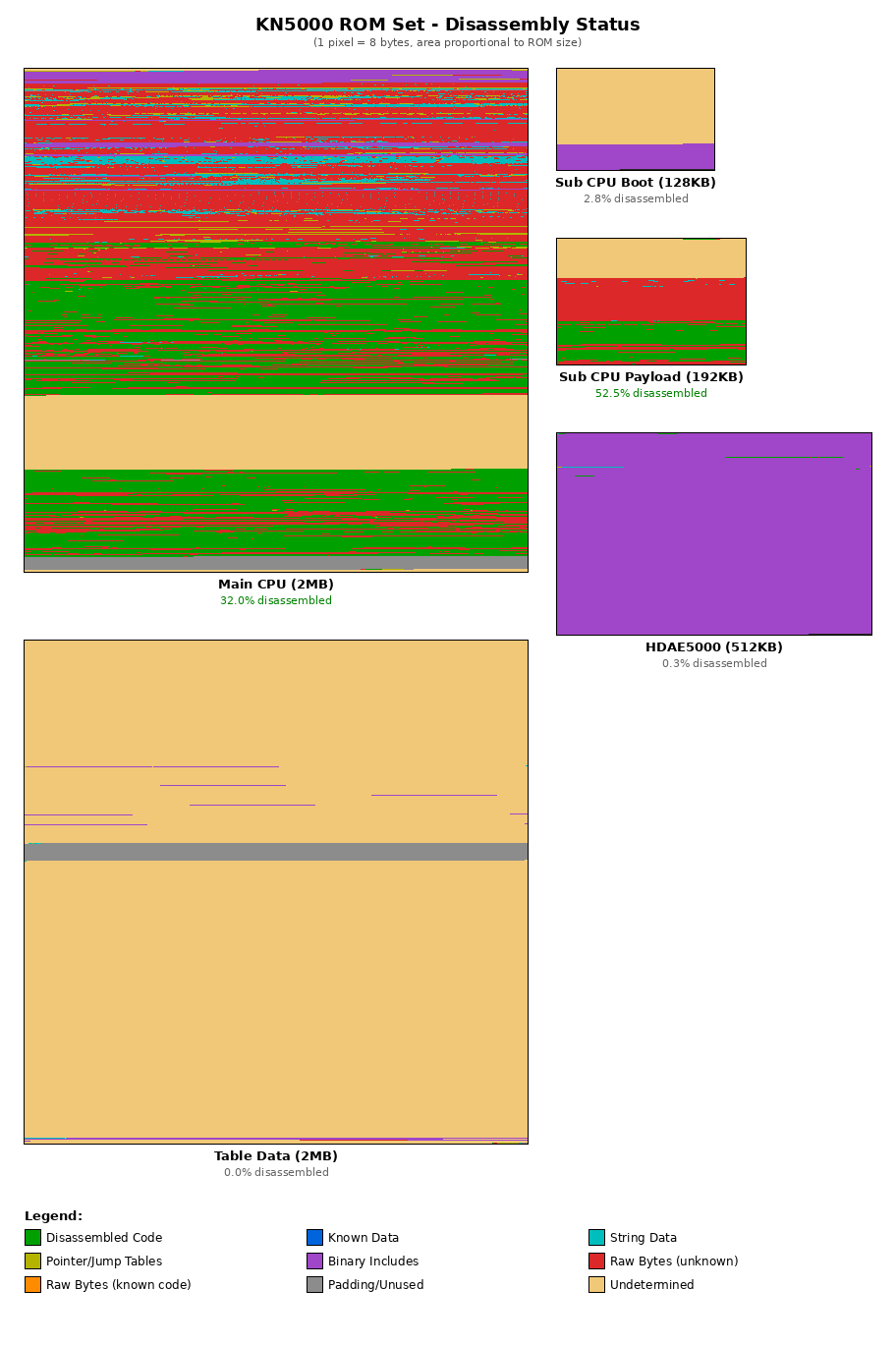
Legend: green = disassembled code · blue = known data structures · cyan = strings · light green = pointer/jump tables · purple = binary includes · red = raw bytes, unknown · orange = raw bytes known to be code · gray = padding/unused · yellow = undetermined. Rectangle width is proportional to ROM size.
This image is stale. It was generated on 2026-02-07, before the source tree was reorganised per firmware version, and
scripts/build/generate_rom_status_diagram.pystill looks for the pre-split ASL paths (maincpu/kn5000_v10_program.asm, …) that no longer exist. Treat the picture as historical until the generator is repointed at the.ssources; the tables above are measured from the current tree.
Original ROM Files
The original firmware dumps are stored in original_ROMs/:
| File | Size | Description |
|---|---|---|
kn5000_v10_program.rom |
2MB | Main CPU program ROM (also v9, v7) |
kn5000_subprogram_v142.rom |
192KB | Sub CPU payload (sent by main CPU at boot) |
kn5000_subprogram_v142_compressed.rom |
93,203B | Same payload as shipped on update disks |
kn5000_subcpu_boot.ic30 |
128KB | Sub CPU boot ROM |
kn5000_table_data_rom_odd.ic1 |
1MB | Table data ROM (odd words) |
kn5000_table_data_rom_even.ic3 |
1MB | Table data ROM (even words) |
kn5000_custom_data.ic19 |
1MB | Custom data flash (user storage) |
hd-ae5000_v2_06i.ic4 |
512KB | HDAE5000 hard disk expansion ROM |
ROM interleaving: the table-data ROM uses 16-bit word-level interleaving across two
physical chips. kn5000_table_data.rom is built by alternating 16-bit words from
odd.ic1 and even.ic3, not individual bytes.
Dump Provenance
Byte-identity of a rebuild says nothing about whether the original file is a complete, faithful image of the physical part. Two of the files above are known not to be, and this section records what is measured versus what is assumed. It matters because everything downstream inherits the assumption.
kn5000_subcpu_boot.ic30 — partially dumped, deliberately
Owner testimony (Felipe, 2026-08-08), which is ground truth about what was physically
done. IC30 was dumped in small chunks, because the tooling could only copy a limited
amount at a time. He read the regions that appeared to hold the boot code needed to make
the emulator work, analysed that code, and — as far as he could assess at the time — found
no references to addresses in the regions he had not read. He concluded the remainder was
very likely 0xFF. He calls this an educated guess, not a fact, and intends a full
dump when he regains physical access to the instrument (it is currently in storage in
another country).
What is measured in the file today:
| Quantity | Value |
|---|---|
| File size | 131,072 bytes (sha1 d29429a9…) |
Bytes that are not 0xFF |
4,352 — 3.3% of the chip |
Non-0xFF content, block 1 |
file 0x18000-0x1904C = CPU 0xFF8000-0xFF904C, 4,173 B |
Non-0xFF content, block 2 |
file 0x1FE80-0x1FFB3 = CPU 0xFFFE80-0xFFFFB3, 308 B |
Non-0xFF content, block 3 |
file 0x1FFF0-0x1FFFF = CPU 0xFFFFF0-0xFFFFFF, 16 B |
| Windows actually read | 0xFE0000-0xFE07FF, 0xFF7800-0xFF97FF, 0xFFF000-0xFFFFFF — 14,336 B, 10.9% of the chip |
| Bytes never read | 116,736 — 89.1%, present in the file as assumed 0xFF |
The three window sizes are corroborated by the driver’s own comment and by the owner’s
dump script, whose chunking constant is 0x800. But note that the window boundaries are
documentary, not measurable: a byte that was read and came back blank is
byte-indistinguishable from a byte that was never read. Roughly 10 KB of the ranges the
driver comment says were dumped are also 0xFF.
MAME flags the file BAD_DUMP and states the assumption inline. A full re-dump would
convert 116,736 assumed bytes into measured ones and let that flag be removed.
What the educated guess survives. A structure-aware reference census over the
disassembled boot ROM — which rebuilds byte-identically, so the census is over ground
truth rather than a linear-decode guess — found 220 ROM-address operand references, all
in dumped windows, none in an undumped range. The 45 live interrupt-vector entries, the
45 ROM trampolines, and the one indirect CALL T,XWA (bounded by an 8-entry table) all
resolve into dumped space, as do the only two callbacks the loaded v1.42 payload makes
into IC30 (0xFFFEA1, 0xFFFE86). There is one honest counter-example, ROM_CHECKSUM
(0xFF8AB4), which reads 2 KB past the dumped window at 0xFE0000; it is
content-independent and its only caller returns immediately unless a strap is asserted.
The code island also does not run up against a dump boundary anywhere: 2,048 blank bytes precede it, 1,971 follow it, and the chip’s first 2,048 bytes were read and came back blank.
What the guess does not yet survive: a rigorous check. The adversarial re-verification
graded the educated guess UNDECIDED, not corroborated. Its objection
is method: the enumeration it asks for — the targets of real JP/JR/CALL/CALR
instructions plus the vector-table entries, taken out of a disassembly — has never been run
and committed as an auditable artifact, and raw byte scans do turn up candidates. Two
concrete ones: the little-endian long at 0xFF8C44 is 0x00FF42A3 and the one at
0xFF8C4A is 0x00FFCFEB, both pointing into never-read space. Neither survives contact
with the source — both fall inside the black-key comparison chain of
NOTE_VELOCITY_LOOKUP_CALCULATE, and neither constant appears as an operand anywhere in
the assembly — which is exactly the point: at this data volume raw scans manufacture
coincidences, so only a structure-aware enumeration counts. Redoing the check properly is
cheap and is still outstanding. See
Sub-CPU Boot ROM (IC30) for the full record.
What it cannot settle. A full IC30 dump would not answer the sub-CPU payload question. The payload is 196,608 bytes; the entire chip is 131,072; the undumped part is 116,736; the boot ROM has no decompressor; and IC30 is not in the main CPU’s address space at all. See Sub-CPU Payload Provenance.
kn5000_custom_data.ic19 — real content, but missing the payload region
The image is a genuine chip read — the 77,824-byte block of 0x00 at chip 0x0C0000 is
actively programmed content, and flash erases to 0xFF, so it cannot be padding. Ten
independent structural anchors land exactly where the firmware’s own hardcoded pointers
say they should, which rules out any rotated, offset or wrapped read.
But the last non-0xFF byte is at chip 0x0D344F, and chip 0x0E0000-0x0FFFFF
(CPU 0x3E0000-0x3FFFFF) — the sub-CPU payload staging area — is entirely blank. Since
every dumped firmware version reaches that source, a machine matching this image could
not start its sub-CPU. Whether the region was never programmed on that unit, or an
install was interrupted, or the dump is truncated and 0xFF-padded, is unresolved:
the three are byte-indistinguishable in the file. The full argument, and the two free
measurements that would decide, are on
Sub-CPU Payload Provenance.
The MAME driver papers over the gap with a ROMX_LOAD overlay of the compressed payload
carved from a genuine update floppy. That composite is a reconstruction, and nothing
in the ROM definition marks it as one.
Note also that
/home/fsanches/compartilhado/kn5000_custom_data_with_preset.ic19is not independent chip evidence: it is byte-identical to the canonical dump except for a 27,967-byte SLIDE4K blob grafted at chip0x0E0000— a different, smaller blob than the 93,203-byte v1.42 subprogram.
kn5000_v10_program.rom versus the physical program flash
A reasonable worry, given the KN7000 precedent — where the “program ROM” we hold turned out
to be the update payload, which deliberately omits the top 0x90FF of the part and so
leaves it neither shipped nor dumped — is whether the KN5000 main-program image has the same
blind spot. (On the KN7000 that gap was for a while assumed to hold the resident updater;
that assumption is refuted
— real hardware reads the region as erased — but the payload is not the whole chip point
stands, which is what makes the worry reasonable.)
It does not. The v10 update floppy’s HKMSPRG.SLD carries a SLIDE4K stream whose
header declares a decompressed size of 0x200000 — the full 2 MB — and decoding it
reproduces kn5000_v10_program.rom byte for byte (2,097,152/2,097,152, consuming
965,545/965,545 input bytes; independently reproduced twice with separately written
decoders). The type 001h and 007h handlers chip-erase the pair before writing, so an
update rewrites the entire device and no region is left uncovered.
That identity does not by itself prove how the file was acquired — a chip read of a v10-updated machine and a decompression of the disc must agree — but it makes the distinction moot for preservation purposes.
The same measurement establishes the v10 ↔ v1.42 pairing as fact rather than inference: both images come off the same floppy. The v141 → v7/v8 and v140 → v5/v6 pairings that MAME’s BIOS options assert are not measured — only the v10 disc is available here.
Reference disassembly files (.unidasm) are generated with MAME’s unidasm tool for analysis.
Assembler
The project uses a custom LLVM backend (llvm-mc -triple=tlcs900) for assembly. All
instructions are encoded natively — no workaround macros needed.
Build process:
llvm-mcassembles.sfiles to ELF object filesld.lldlinks with a linker script that sets the ROM base addressllvm-objcopyextracts the raw binary from the ELF- generated payloads (demo presets, help databases, the v142 update image) are
recompressed and
cmp-checked compare_roms.pyverifies every section byte-for-byte against the originals
cd kn5000-roms-disasm

make gate-all                         # the gate: thirteen images, byte-exact or non-zero exit

# the full similarity report: expect FIFTEEN sections, all 100.00%
make clean-all && make all && make asl-all && python3 scripts/build/compare_roms.py

make all                              # LLVM sections only (nine) + compare
python3 scripts/build/compare_roms.py # compare whatever is already built
make verify-demo-presets              # 19/19
make verify-help-databases            # 6/6
make audit-icons-blob                 # coverage report for icons_to_strings.bin
Two toolchains, and the LLVM one is authoritative. The LLVM TLCS-900 backend encodes
the TLCS-900/H2 instruction set natively. A second set of sources for ASL (Alfred Arnold’s
Macro Assembler) is archived in archive/asl/ and is still built and verified; ASL supports
only the TMP96C141, so those sources carry 110+ workaround macros for the TMP94C241F’s own
instructions — which is why they are the archived set and not the primary one.
Source Organisation
Each firmware version has its own tree (v7/, v9/, v10/ for the maincpu; v142/ for
the sub-CPU payload), with shared/ modules included by more than one ROM.
The three maincpu trees are split by subsystem, not monolithic: each is about 156 .s
files across roughly twenty directories, and the three carry the same file layout so a
routine sits at the same path in all of them. The remaining images are far smaller and are
not split that way — v142/subcpu is 5 files, hdae5000 8, table_data 26, and the
sub-CPU boot ROM and custom-data flash are a single file each.
Symbol names live outside the sources, in symbols/*_symbols_reference.txt; the three
maincpu trees share maincpu_symbols_reference.txt and each also has a per-version file.
File and line counts move with every conversion; measure them rather than quoting one:
find v10/maincpu -name '*.s' | wc -l
find v10/maincpu -name '*.s' -exec cat {} + | wc -l
The per-file breakdown lives on the Source Code Map page, and the diagram view of how the directories relate is on Architecture Flowchart.
Instruction census
How the source spells its instructions, for the v10 main-CPU tree. Produced by
python3 notes/syntax-convergence-probes/mnemonic_census.py --root v10/maincpu
which prints to stdout and writes nothing unless given --out:
| Bucket | Sites | Distinct names |
|---|---|---|
| Instruction statements, total | 336,011 | 359 |
— a native LLVM mnemonic unidasm also has |
294,233 | 68 |
| — a tree-local synthetic name encoding the operand form | 40,071 | 266 |
— a .macro defined inside the tree |
1,705 | 23 |
| — unclassified | 2 | 2 |
Of the synthetic names, 6,020 sites over 79 names are byte emitters wearing a mnemonic’s name: their operands are literal mode and displacement bytes rather than modelled operands, so no rename reaches them until the operand is modelled. What retiring the rest would take is on LLVM Semantic Instructions.
Symbol count is a wc -l on the reference file, which carries one symbol per line:
grep -c LABEL_ symbols/maincpu_symbols_reference.txt # 0
The file’s own header block carries the count, regenerated with it by
scripts/analysis/l2_symbol_reference.py --regen: 39,393 symbols, of which 35,765 (90.8 %)
have semantic names and 3,628 are positional. No opaque LABEL_XXXXXX placeholders remain, in
that file or in any of the other seven symbols/*_symbols_reference.txt. Note the file is
v10 only — it agrees with the v7 ELF at 25.96 % — so each version also has its own.
Subsystem entry points (main CPU):
- FDC —
storage/fdc_routines.s:FDC_COMMAND_DISPATCHER, per-command handlers,Reset_Floppy_Disk_Controller,Check_for_Floppy_Disk_Change;fdc_constants.sholds the 0x110000-base I/O addresses, uPD765-compatible command codes and status-bit definitions. - MIDI / encoders —
midi/midi_encoder_routines.s:CPanel_EncoderDispatch,Encoder_ProcessModwheel/Volume/Breath/Foot/Expression. - Control panel —
ui/cpanel_routines.s: serial state machine (CPanel_SM_*), packet processors (CPanel_RX_*), LED control, buffer management. - SysEx —
midi/sysex_routines.s:ExcSendFunc,ExcPmemFunc,ExcSmemFunc,ExcCompFunc,ExcSeqFunc,ExcMspFunc. - Feature demo —
demo/demo_routines.s,demo/fdemotext_routines.s. - Computer interface —
midi/computer_interface_config.s,midi/computer_interface_pcg.s. - File I/O —
file_io/: title handlers, disk operations, filename/password UI, composer filters, SMF operations, wallpaper loading, single load, medley, misc UI. - GUI constants —
gui_constants.s: display dirty flags (0x0205E4), offscreen buffer addresses (0x043C00, 0x056800, 0x05FE00, 0x069400), 320×240 @ 8bpp.
Sub CPU Boot ROM
The 128 KB sub-CPU boot ROM rebuilds at 100.00% — against a file that is 97% 0xFF and
89% never read, so read that number together with Dump Provenance
above and with Sub-CPU Boot ROM (IC30). Routines
identified include the tone generator init loop (SUB_8437), register-pair writers,
COPY_WORDS/FILL_WORDS, CHECKSUM_CALC, the inter-CPU handler set, and the
debug/diagnostic tail at 0xFFFE80.
DMA transfer routines (0xFF8604–0xFF881E):
| Routine | Address | Size | Description |
|---|---|---|---|
SendData_Chunked |
0xFF8604 | 69 bytes | Send data in 32-byte chunks via DMA |
SendData_Block |
0xFF8649 | 99 bytes | Send single data block via DMA |
SendCmd_E3 |
0xFF86AC | 48 bytes | Send E3 (payload ready) command |
SendParams_E2 |
0xFF86DC | 112 bytes | Wait for DMA, then send E2 command |
TwoPhase_Transfer |
0xFF874C | 211 bytes | Two-phase DMA with E1 command, 200-cycle delays |
The 656-byte data region at 0xFF8000–0xFF828F is now source. A single .incbin was
hiding eight cross-referenced objects: an 8-entry command-handler jump table of .long
code pointers, a RAM-test region descriptor, and the tone generator’s velocity/touch front
end. The last six of those objects also exist, byte-identical, in the v1.42 payload, so
they carry the payload’s own names. The tree now contains no .incbin at all — the blob
file stays on disk only because the ASL mirror still bincludes it. Full breakdown:
Sub-CPU Boot ROM (IC30).
Bear in mind what “rebuilds at 100.00%” means for this particular image: 116,736 of its
131,072 bytes were never read off the chip and are present in the file as assumed 0xFF,
and only 4,352 bytes in the whole image are not 0xFF. Reproducing assumed bytes is not an
achievement. See the dump-provenance section above.
Table Data ROM
The table-data ROM holds the first-stage bootloader plus almost all factory data. See Table Data ROM for the region-by-region reference and Memory Map for the current layout.
First-stage bootloader (0x9FB496–0x9FFFFF). All of it is now symbolic assembly. At
reset the table-data ROM is mapped at 0xE00000–0xFFFFFF, so ROM address 0x9Fxxxx executes
at boot-time alias 0xFFxxxx (+0x600000) until Boot_Init reprograms the memory
controller. Source labels are at ROM addresses; the 0xFFxxxx aliases appear in comments,
and the handful of CALL-absolute sites that must stay numeric are marked as such.
| Component | Address range | Module |
|---|---|---|
| FDC dispatch offset tables | 0x9FB496–0x9FB4D1 | kn5000_table_data.s (three tables) |
Boot_BitMaskTable + Boot_InitParams |
0x9FB4D2–0x9FB4E7 | kn5000_table_data.s |
Boot_Init, halt handler, Boot_ClearRAM |
0x9FB4E8–0x9FB7F1 | kn5000_table_data.s, shared/ |
| HDAE5000 boot-flash tail | 0x9FC6F6–0x9FC8C1 | kn5000_table_data.s (was bootcode_hdae_to_lzss.bin) |
| LZSS decoder suite | 0x9FC8C2–0x9FCC29 | kn5000_table_data.s (872 bytes, five routines) |
| FDC command-layer driver | 0x9FD8A5–0x9FEA9C | boot_fdc_driver.s |
| Disk-format probe | 0x9FEB2B–0x9FEC6D | boot_disk_probe.s |
| CP-serial driver (polling half) | 0x9FEC6E–0x9FF228 | boot_cpserial.s |
| CP-serial ISRs | 0x9FF229–0x9FF2F1 | boot_cpserial_isr.s |
| CP-serial state handlers/codecs | 0x9FF2F2–0x9FFB2E | boot_cpserial_states.s |
| Boot C runtime | 0x9FFB2F–0x9FFE7F | boot_clib.s |
| Debug group (disabled) | 0x9FFE80–0x9FFEDF | boot_debug.s |
RESET_HANDLER + IVT |
0x9FFEE0–0x9FFFFF | kn5000_table_data.s |
The LZSS decoder is SLIDE4K (4 KB sliding window, 12-bit offset, 4-bit length) and is invoked during flash firmware updates:
| Routine | Address | Size | Purpose |
|---|---|---|---|
LZSS_ReadByte |
0x9FC8C2 | 115 bytes | Read from compressed stream with sector buffering |
LZSS_OutputByte |
0x9FC935 | 63 bytes | Write decompressed bytes with 32-bit batching |
LZSS_OutputByte_Alt |
0x9FC974 | 63 bytes | Alternative output for flash update mode |
LZSS_ParseHeader |
0x9FC9B3 | 157 bytes | Parse/validate firmware header, set up source |
LZSS_Decompress |
0x9FCA50 | 474 bytes | Main decompression loop with sliding window |
(The 4 KB/8 KB variant dispatch lives in the main-CPU firmware, not here — see the help database note above.)
System update bitmaps (shared with the main CPU). Eight 1-bit monochrome images
(224×22 px, 616 bytes each) at 0x9FA156, byte-identical to the main-CPU copies; both ROMs
.incbin the same files.
| Address | Image |
|---|---|
| 0x9FA156 | Flash Memory Update |
| 0x9FA3BE | Now Erasing |
| 0x9FA626 | FD to Flash Memory |
| 0x9FA88E | Completed |
| 0x9FAAF6 | Please Wait |
| 0x9FAD5E | Change FD 2 of 2 |
| 0x9FAFC6 | Illegal Disk |
| 0x9FB22E | Turn On AGAIN |
Key discovery (still valid): the interrupt vector table holds boot-time addresses (0xFFxxxx) precisely because of the reset-time mapping described above.
Shared source with the Main CPU
Several bootloader routines are byte-identical or semantically identical to main-CPU
utilities — both ROMs were built from common source. The disassembly now uses real shared
modules in shared/:
| File | Description |
|---|---|
shared/vga_constants.s |
VGA register addresses and constants |
shared/vga_init.s |
VGA initialization data + completion code |
shared/vga_io.s |
VGA register I/O routines (byte-identical between ROMs) |
shared/boot_call_init_handlers.s |
Init handler dispatch (conditional assembly) |
shared/boot_routines.s |
Boot initialization routines + LZSS decoder |
shared/macros.s, shared/sfr_tmp94c241.s |
Macros and SFR definitions |
Shared routine mapping:
| Table Data | Main CPU | Size | Routine |
|---|---|---|---|
| 0x9FCDFC-0x9FCE1D | 0xEF5141-0xEF515F | 30-34 bytes | Write_VGA_Register, Read_VGA_Register |
| 0x9FB70A-0x9FB73F | 0xEF086F-0xEF08A3 | 53-54 bytes | Boot_CallInitHandlers |
| 0x9FCD9A-0x9FD7BD | 0xEF50DF-0xEF5B02 | 2,596 bytes | VRAM_FillRect and display routines |
| 0x9FBC3C-0x9FBECF | 0xEF3CE0-0xEF3F73 | 660 bytes | Boot utility routines |
| 0x9FB4F2-0x9FB622 | 0xEF03D0-0xEF0500 | 305 bytes | Boot initialization code |
Where the two ROMs differ in encoding (byte vs word compare, different helper addresses), conditional assembly handles it — each ROM defines the required parameters before including the shared file.
Technical Notes
TMP94C241F vs TMP96C141
Instructions unique to TMP94C241F that required macro workarounds under ASL:
- Memory-to-memory
LD(not supported by TLCS-900) - Certain shift/rotate variants
- Some MUL/DIV variants
- LDI, LDIR, LDD, LDDR block transfer instructions
- DMA control register access (
LDCwith DMAS/DMAD/DMAC/DMAM registers)
The LLVM backend encodes all of these natively; the macro tables below document the archived ASL mirror, which is still built.
ASL Macro Workarounds (tmp94c241.inc)
DMA register macros:
| Macro | Encoding | Description |
|---|---|---|
LDC_DMAS0_XWA |
e8 2e 00 |
Load DMA source 0 from XWA |
LDC_DMAS2_XDE |
ea 2e 08 |
Load DMA source 2 from XDE |
LDC_DMAS2_XHL |
eb 2e 08 |
Load DMA source 2 from XHL |
LDC_DMAD0_XWA |
e8 2e 20 |
Load DMA destination 0 from XWA |
LDC_DMAD0_XBC |
e9 2e 20 |
Load DMA destination 0 from XBC |
LDC_DMAD2_XWA |
e8 2e 28 |
Load DMA destination 2 from XWA |
LDC_DMAC0_WA |
d8 2e 40 |
Load DMA count 0 from WA |
LDC_DMAC0_A |
c9 2e 42 |
Load DMA count 0 from A |
LDC_DMAC2_A |
c9 2e 4a |
Load DMA count 2 from A |
LDC_DMAC2_BC |
d9 2e 48 |
Load DMA count 2 from BC |
LDC_DMAC2_WA |
d8 2e 48 |
Load DMA count 2 from WA |
Additional sub CPU boot ROM macros:
| Macro | Encoding | Description |
|---|---|---|
INC_0_XBC |
e9 60 |
Increment XBC by 1 |
PUSH_WORD value |
0b LL HH |
Push 16-bit immediate |
CP_pXWA_WORD value |
90 3f LL HH |
Compare (XWA) with 16-bit immediate |
CP_pXBC_d_WORD d,val |
99 dd 3f LL HH |
Compare (XBC+d) with 16-bit immediate |
LDA_XWA_IMM24 value |
f2 LL MM HH 30 |
Load 24-bit address into XWA |
CALR target |
1e LL HH |
Call relative (3-byte encoding) |
CALL_ABS24 target |
1d LL MM HH |
Call absolute with 24-bit address |
JRL_T target |
78 LL HH |
Jump relative long (always true) |
LDIR_94 |
83 11 |
Block copy (TMP94C241 encoding) |
LD_A value |
21 nn |
Load immediate to A register |
LD_D value |
24 nn |
Load immediate to D register |
LD_E value |
25 nn |
Load immediate to E register |
LD_L value |
27 nn |
Load immediate to L register |
LD_W value |
20 nn |
Load immediate to W register |
LD_pXIX_IMM16 value |
b4 02 LL HH |
Store 16-bit imm to (XIX) |
LD_pXHL_IMM16 value |
b3 02 LL HH |
Store 16-bit imm to (XHL) |
LD_MEM24_IMM16 addr,val |
f2 LL MM HH 02 VV WW |
Store 16-bit to 24-bit addr |
Stack frame and register macros (DMA routines):
| Macro | Encoding | Description |
|---|---|---|
DEC_6_XSP |
ef 6e |
Decrement XSP by 6 (allocate stack frame) |
INC_6_XSP |
ef 66 |
Increment XSP by 6 (deallocate stack frame) |
LD_IZ_BC |
d9 8e |
Load IZ from BC |
CP_IZ_imm16 val |
de cf LL HH |
Compare IZ with 16-bit immediate |
SUB_IZ_imm16 val |
de ca LL HH |
Subtract 16-bit immediate from IZ |
LD_C_IZL |
c7 f8 8b |
Load C from low byte of IZ |
EXTZ_WA |
d8 12 |
Zero-extend A to WA |
EXTZ_BC |
d9 12 |
Zero-extend C to BC |
Stack-relative addressing macros:
| Macro | Encoding | Description |
|---|---|---|
LD_A_pXSP_d disp |
8f dd 21 |
Load A from (XSP+disp) |
LD_XDE_pXSP_d disp |
af dd 22 |
Load XDE from (XSP+disp) |
LD_XBC_pXSP_d disp |
af dd 21 |
Load XBC from (XSP+disp) |
LD_pXSP_d_A disp |
bf dd 41 |
Store A to (XSP+disp) |
LD_pXSP_d_XDE disp |
bf dd 62 |
Store XDE to (XSP+disp) |
ADD_pXSP_d_XWA disp |
af dd 88 |
Add XWA to (XSP+disp) |
Encoding Differences
ASL sometimes chooses different (but functionally equivalent) encodings than the original ROM:
| Instruction | Original | ASL Default | Notes |
|---|---|---|---|
lda XWA, imm16 |
5-byte (24-bit addr) | 4-byte (16-bit) | Use LDA_XWA_IMM24 macro |
call addr |
3-byte calr |
4-byte call |
Use CALR macro when target is within range |
jp addr |
3-byte jrl T |
4-byte jp |
Use JRL_T macro for relative long jump |
ldir |
83 11 |
85 11 |
Use LDIR_94 macro for TMP94C241 encoding |
ld A, imm8 |
21 nn |
Different | Use LD_A macro |
ld D, imm8 |
24 nn |
Different | Use LD_D macro |
How the source represents the ROM
Code spelled as data
Executable code is written as native TLCS-900 mnemonics wherever it has been identified as
code. It is not true that no code remains as .byte: the sub-CPU payload, the sub-CPU
boot ROM, table data, custom data and all four SX-WSA1R images are at zero, while v7 holds
275,822 B and HD-AE5000 11,783 B of instructions still spelled as data. The per-image
figures and the method that measures them are on
Raw Byte Code Elimination.
Data tables held as C
Structured data is source as typed C rather than byte arrays wherever the shape is known:
15 sound-data files in audio/sound_data/ and 29 NAKA widget descriptor blocks are
__attribute__((packed)) struct initializers with named fields and _Static_assert size
checks, compiled and .incbin‘d so the ROM stays byte-identical. These are data only —
no firmware routine is written in C; see
ScreenData C conversion and
UI Widget Types.
The IC307 waveform ROM’s format is decoded — 16-bit signed PCM at 32 kHz with a 512-entry sample table — on Waveform ROM Format.
Binary include splitting policy
Binary includes are split whenever code references an address inside them, so that
cross-references use symbolic labels instead of hardcoded addresses and structure
boundaries are explicit. A slice must also carry a label, a length and a comment saying what
it holds — an unnamed whole-file .incbin is treated as an unfinished conversion.